

Dr. Leonard Swidler Ph.D.
Interreligious and intercultural dialogue – critical thinking – ethics – intellectual, cultural history – Catholic theology and history – history – global ethics – feminism – Jesus – Biblical studies
Dr. Leonard Swidler is the Founder & President of the Dialogue Institute and Professor of Catholic Thought and Interreligious Dialogue in the Religion Department of Temple University. At Temple and as a visiting professor at many universities around the world– he has mentored a generation of U.S. and international scholars in the work of interreligious dialogue. He has proposed a ‘Universal Declaration of a Global Ethic,’ based on various religious and ethical communities, ethnic groups, and geographical religions, encouraging work and discussion in drafting their own versions of a global ethic.
Published Works
Leonard Swidler is the author of over 100 books; these are some favorites.
Available at iPub Global Connection LLC and Amazon.com
*See footnotes for product summaries.






Leonard Swidler and Sandi Billingslea, Founders of iPub Global Connection Publishing
iPub Global Connection LLC is the brainchild of Sandi Billingslea. Originally built to showcase the distinguished academic library of works by Sandi’s brother Professor Leonard Swidler, close to a decade later, iPub Global has grown into so much more.
For Media Packages and Interviews
info@ipubglobalconnection.com
Footnotes
- Jesus Was a Feminist: What the Gospels Reveal about His Revolutionary Perspective
The result of four decades of research, Jesus Was a Feminist, compellingly presents the case that Jesus treated women equally with men, and he boldly broke the customs of his day to involve them in his work. Renowned scholar and leader among liberal Catholics, Leonard Swidler examines all gospel texts involving women, asserts that women were involved in the writing of two of the gospels, and outlines the importance of women in Jesus’ ministry and the creation and development of the early church. He shows how Jesus was a feminist and modern Christians should be too. ↩︎ - Biblical Affirmations of Woman
Here is a comprehensive, one-volume commentary on what the Bible really says about women. In this well-documented topical review, every positive biblical reference about women is quoted in full, set in context, and provided with a brief exposition. Over 350 specific topics are examined. ↩︎ - Yeshua: Jesus the Jew a Model for Everyone
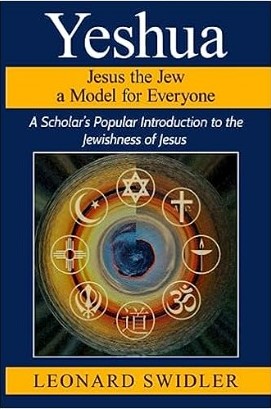
Rabbi Yeshua, that religious Jew who walked this earth two thousand years ago, is presented anew through the refracting lenses of the four gospels and the picture of the dynamic, turbulent, then-contending various ‘Judaisms’ (plural intended) of his time. In presenting this emergent image of Yeshua: Jesus the Jew a Model for Everyone, now in its third edition, Leonard Swidler speaks as a modern Christian theologian—not so much about Christ, but about the historical Jesus, or rather, Rabbi Yeshua ha Notzri (Rabbi Jesus the Nazorean). Dr. Swidler presents a timeless model for how to live today a fully human life by taking on responsibility for the oppressed of society, breaking through anti-feminine stereotypes, and living an “androgynous” model; for all (not just Christians) to follow. ↩︎ - The Study of Religion in an Age of Global Dialogue
Religion is the most fundamental and comprehensive of all human activities. It tries to make sense out of not simply one or another aspect of human life but all aspects of human experience. At the core of every civilization lies its religion, which both reflects and shapes it. Thus, if we wish to understand human life in general and our specific culture and history, we need to understand religion. ↩︎ - The Power of Dialogue: Jewish – Christian – Muslim Agreement and Collaboration
Much of the world believes that Islam, Judaism, and Christianity are three vastly different faiths. It is not difficult to understand why one might make this assumption; each has its own history, texts, and practices that, without further investigation, appear quite distinct. But are these religions really so dissimilar? And with religion being an issue held dear by so many, how do we compare them in a way that brings us closer together instead of dividing us? ↩︎ - Breakthrough to Dialogue: The Story of Temple University Department of Religion
This is the story of a group of pioneering professors who, in 1966, brought their diverse traditions into Temple University’s Department of Religion and explored whether they could learn from and understand each other. Temple’s religion program was already breaking new ground as one of the first such departments in a public university. From the beginning, Temple had made an effort to hire scholars of different religious backgrounds and beliefs: Catholics, Protestants, Jews, Muslims, Hindus, Buddhists, and those who adhered to no organized religion ↩︎ - Buddhism Made Plain
This book will not only answer that question but will also help you learn to relax and show you why meditation is not a new thing. Do you know people who say they are Buddhist or practice Buddhism yet were raised Catholic or Jewish and wonder how they practice two religions? Did they say that they have found a way to feel peaceful and content by practicing Buddhism? Like other religions, Buddhist ideas are more than 2,500 years old. In the last 60 years, while many religions have declined in numbers, the teachings of the Buddha have been growing and becoming more and more integrated into an increasingly secular culture. ↩︎ - The Uniqueness of Jesus: A Dialogue with Paul F. Knitter
Since the publication of his landmark book, No Other Name? Paul Knitter’s work has crystallized discussions and defined some of the most basic questions in Christian theology. This is so particularly in the debate over the uniqueness of Jesus as God’s son and as all of humankind’s sole redeemer. In The Uniqueness of Jesus, Knitter responds to the request of editors Leonard Swidler and Paul Mojzes to state the most adequate case for a viable Christian theology of religions and for the demands of living ecumenically in a religiously plural world. The result is Knitter’s five basic theses on the “uniqueness of Jesus” that comprise the opening statement in this dialogue. In response, a score of influential women and men comment on these five theses, including Harvey Cox, Monika Hellweg, Hans Kung, Wesley Ariarahah, Clark H. Pinnock, Jose Miguez Bonino, John McQuarrie, Raimon Panikkar, John Sanders, John Mbiti, Ingred Shafer, Michael Alamadoss, Kajsa Ahlstrand, Michael von Bruck, John B. Cobb Jr., Kenneth Cragg, Antony Fernando, John Hick, Karl-Josef Kuschel, and Seiichi Yagi. Knitter then responds to his critics, some of whom, he concedes, make substantial points that reveal the difficulties in the road ahead. ↩︎ - Movement for a Global Ethic: An Interreligious Dialogue
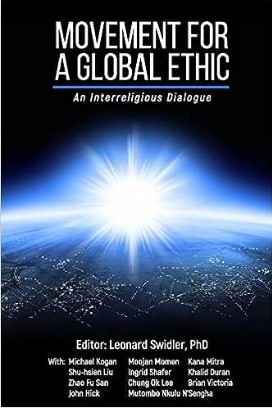
The Global Ethic is the set of basic principles of right and wrong which, in fact, are found in all the major, and not so major, religions and ethical systems of the world, past and present. It does not go beyond the existing commonalities. However, this de facto existing broad basic agreement on ethical principles, unfortunately, is largely unknown by most religious and ethical persons. If they were aware of this commonality, that would provide a broad basis for serious dialogue and collaboration among the adherents of all the religions and ethical systems of the world. Lacking that awareness, far too often, different religions and ethical systems foster destructive rather than constructive relations. Hence, it is vital to foster a conscious knowledge of the de facto existing Global Ethic. ↩︎ - Three Jesus Certitudes: Pacifism, Feminism, and the Birth of Christianity
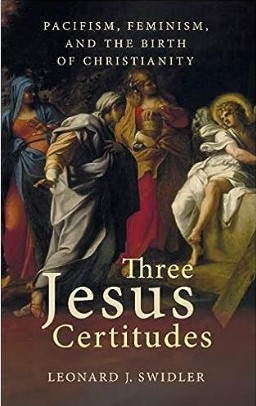
The Jesus of the four Gospels–and we have no knowledge of any other–appears mainly as a healer and a teacher–that is, as a healer of the soul. Three of the historically most certain facts about him were (1) his pacifism, (2) his feminism, and (3) that his women followers were the true founders of Christianity! The proof of these astounding claims you will find in the book. ↩︎ - Dialogue for Interreligious Understanding: Strategies for the Transformation of Culture-Shaping Institutions (Interreligious Studies in Theory and Practice)
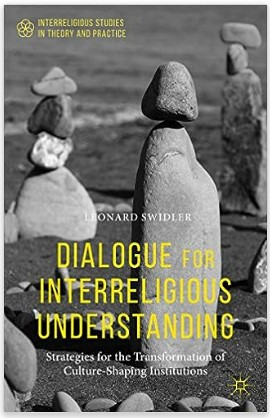
This book gathers the cumulative insights of over sixty years of Leonard Swidler’s work in interreligious, intercultural dialogue. Offering a “Dialogue on Dialogue,” he shows why diatribes, debates, and the like are ultimately unproductive and destructive. Swidler lays out his methods for engaging in Deep-Dialogue, Critical-Thinking, Emotional-Intelligence, Competitive-Cooperation, as well as “common sense” guidelines for the novice and expert alike on how to move beyond one’s own perspective to experience real encounters and dialogue – and live accordingly! ↩︎ - Authentic Humanity: The Human Quest for Reality and Truth (Big Little Books)
This book, which explores our uniquely human quest for reality and truth, is at the heart of Dr. Leonard Swidler’s exploration of our existence. This is a timely release as our country struggles with the deepest meaning of “what is truth” and “reality?”
After the sudden end of the Cold War in 1989, the term’ dialogue,” which had hardly been heard of before the Catholic Second Vatican Council (1962-65) and had been gaining popularity since, became so popular that Professor Leonard Swidler and his colleagues created the term Deep Dialogue to indicate they were talking about this largely recent, transformative, whole new way of thinking. ↩︎ - Letters to Will (6-book series)
Everyone struggles at times to answer important life questions. What is right and wrong? What is the meaning of life? Why do people believe different things?
Professor Leonard Swidler, author of more than 100 books, has explored these questions with many other professors across the world. Now, with his 15-year-old granddaughter, Will, he explores deep human issues, not with heavy language, but with thoughts and words from an experienced grandpa to his open-eyed, open-hearted granddaughter. ↩︎
 Leonard Swidler