

“We Humans must be the Lead Dancers in The Cosmic Dance of Dialogue!“
A Commentary by Leonard Swidler, PhD.
I.
Nobody Knows Everything about Anything—Therefore Dialogue!
In the dawning Age of Global Dialogue, we humans are increasingly aware that we cannot know everything about anything. This is true for the physical sciences: No one would claim that she or he knows everything about biology, physics, or chemistry. Likewise, no one would claim that we know everything about the human sciences, sociology, or anthropology, or—good heavens, economics!—and each of these disciplines is endlessly complicated. In sum—in the form of a mantra:
“Nobody Knows Everything About Anything—Therefore, Dialogue!”
However, when it comes to the most comprehensive, the most complicated discipline of all—Religion—billions of us still claim that we know all there is to know, and whoever thinks differently is simply mistaken! But, if it is true that we always can only know partially in any limited study of reality, as in the physical or human sciences, surely it is all the more true of Religion and Secular Ideologies, which are “explanations of the ultimate meaning of life, and how to live accordingly.”[1] We must, then, be even more modest in our claims of knowing better in this most comprehensive field of knowledge, Religion/Ideology, “the ultimate meaning of life.”
Because of the work of great thinkers like the late Hans-Georg Gadamer and Paul Ricoeur, we now also realize that no knowledge can ever be completely objective, for we, the knower, are an integral part of the process of knowing. In brief, all knowledge is interpreted knowledge. Even in its simplest form, whether I claim that the Bible is God’s truth, or the Qur’ān, or the Gita…. or indeed, the interpretation of it by the Pope, my Rabbi, Shaik, Guru… or it is I who affirm that they teach the complete truth. But, if neither I nor anyone else can know everything about anything, including, most of all, the most comprehensive claims to truth—Religion/Ideology—how do I proceed to search for an ever-fuller grasp of reality, of truth?
II.
From the Age of Monologue to the Age of Global Dialogue!
The clear answer is Dialogue. In Dialogue, I talk with you primarily so that I can learn what I cannot perceive from my place in the world with my personal lenses of knowing. Through your eyes, I see what I cannot see from my side of the globe, and vice versa. Hence, dialogue is not just a way to gain more information. Dialogue is a whole new way of thinking! We are painfully leaving behind the Age of Monologue and are, with squinting eyes, entering into the Age of Global Dialogue!
III.
The Universe Is a Cosmic Dance of Dialogue!
Dialogue—in its most expanded meaning: “The mutually beneficial interaction of differing components”—is at the very heart of the Cosmos, of which we humans are the highest expression:
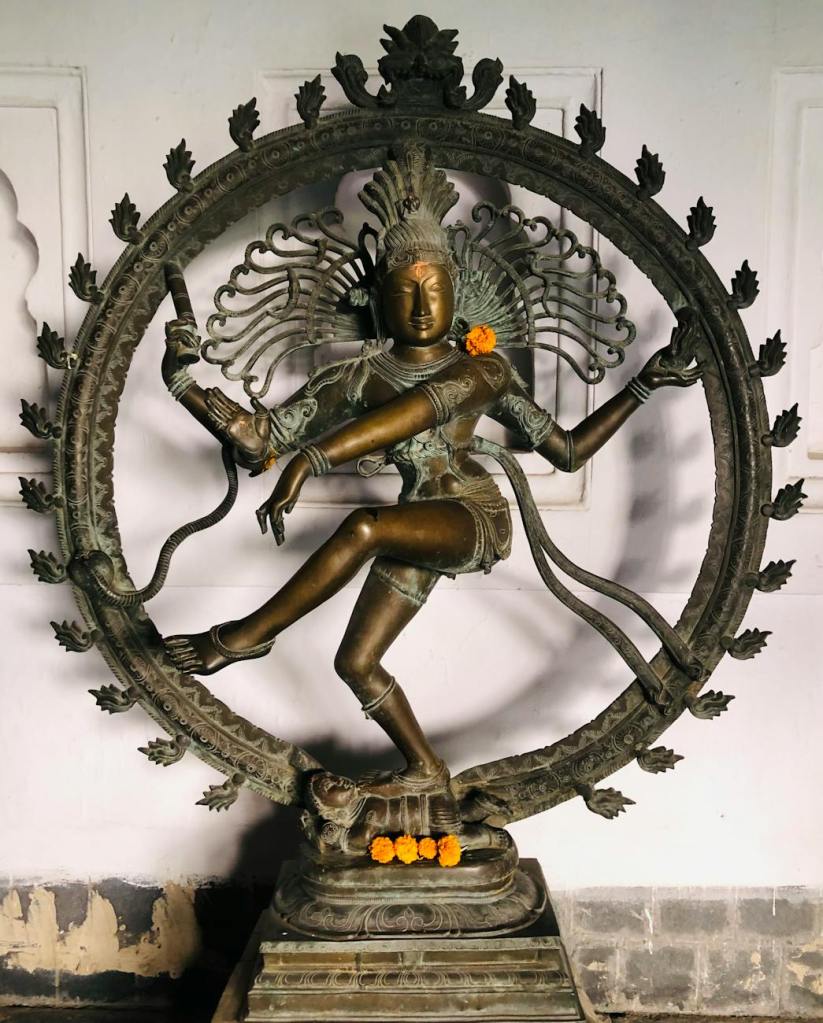
1) On the Macro level of the whole of the Cosmos (expanding since the “Big Bang” 13.8 billion years ago at the speed of light (186.000 mph!): the basic interaction/dialogue of matter and energy (in Einstein’s unforgettable formula: E=MC2; “Energy = mass times the square of the speed of light”) to,
2) on the Micro level, the creative interaction/dialogue of protons and electrons in every atom to
3) the vital symbiosis of body and spirit in every human, through
4) the creative dialogue between woman and man, to
5) the dynamic “humanizing” dialogic relationship between individual and society.
Thus, the very essence of the Cosmos and our Humanity is Dialogical, and a fulfilled Human life is the highest expression of the Cosmic Dance of Dialogue.
In the early millennia of the history of humanity, as we spread outward from our starting point in central Africa, 200,000 years ago, the forces of Divergence were dominant. However, because we live on a globe, in our frenetic divergence we eventually began to encounter each other more and more frequently. Now the forces of stunning Convergence are becoming increasingly dominant.

In the past, during the Age of Divergence, we could live in isolation from each other; we could ignore each other. Now, in the Age of Convergence, we are forced to live in One World. We increasingly live in a Global Village. We cannot ignore the other, the different. Too often in the past we have tried to make over the other into a likeness of ourselves, often by violence, but this is the very opposite of dialogue. This ego-centric arrogance is in fundamental opposition to the Cosmic Dance of Dialogue. It is not creative; it is destructive.
Hence, we humans today have a stark choice: Dialogue, or Death.
IV.
Dialogues of the Head, Hands, Heart in Holistic Harmony of the Holy Human
For us humans there are three main dimensions to dialogue, corresponding to the structure of our humanness: Dialogue of the Head, Hands, Heart, in Holistic Harmony of the Holy Human.

A.
The Cognitive or Intellectual: Seeking the Truth
In the Dialogue of the Head we reach out to those who think differently from us to understand how they see the world and why they act as they do. The world is too complicated for anyone to grasp alone; increasingly, we can understand reality only with the help of the other, in Dialogue. This is important, because how we understand the world determines how we act in the world.
B.
The Ethical: Seeking the Good

In the Dialogue of the Hands we join together with others to work to make the world a better place in which we all must live together. Since we can no longer live separately in this “One World,” we must work jointly to make it not just a house but a Home for all of us to live in. In other words, we join hands with the other to “heal the world”—Tikun olam, in the Jewish tradition. The world, within us, and all around us, is always in need of healing, and our deepest wounds can be healed only together with the other, only in Dialogue.
C.
The Affective or Aesthetic: Seeking the Beautiful, the Spiritual

In the Dialogue of the Heart we open ourselves to perceive/receive the beauty of the other. Because we humans are body and spirit—or, rather, body-spirit—we give bodily-spiritual expression in all the arts to our multifarious responses to life: joy, sorrow, gratitude, anger…. and, most of all, love. We try to express our inner feelings, which grasp reality in far deeper and higher ways than we are able to put into rational concepts and words or every-day deeds; hence, we create poetry, music, dance, painting, architecture….—the expressions of the heart. All the world delights in beauty, and so it is here that we find the easiest encounter with the other, the simplest door to dialogue.
Here, too, is where the depth, spiritual, mystical dimensions of the human spirit are given full rein. As the seventeenth-century mathematician/philosopher Blaise Pascal (1623–1663) said: Le cœur a ses raisons que la raison ne connaît point, (“The heart has its reasons, which reason knows not,” (Pensees, 358).
D.
Holiness: Seeking the One
We humans cannot live a divided life. If we are even to survive, let alone flourish, we must “get it all together.” We must not only dance individually the dialogues of the Head, Hands, and Heart, but also bring our various parts together in Harmony to live a Holistic life, which is what religions mean when they say that we should be Holy (Greek, holos, “whole”).
E.
The Cosmic Dance of Dialogue!
Hence, we are authentically Human only when our manifold elements are in Dialogue within each other, and we are in Dialogue with the other persons and all reality/Reality, around/in us.
We Humans must be the Lead Dancers in The Cosmic Dance of Dialogue!
If you are interested in reading more about the power and necessity of dialogue, you may like these books: The Power of Dialogue: Jewish – Christian – Muslim Agreement and Collaboration by Leonard Swidler and The Study of Religion in the Age of Global Dialogue by Leonard Swidler
[1] Leonard Swidler and Paul Mojzes, The Study of Religion in an Age of Global Dialogue (Philadelphia: Temple University Press, 2000).

 Leonard Swidler